
Getting married can bring questions about sexual health that many men have never had a comfortable opportunity to ask. You may wonder whether your erection is normal, whether you will last long enough during intercourse, whether masturbation has affected you, whether your penis size is adequate, or whether you are fertile.
You do not need to see a sexologist simply because you are getting married. However, a premarital sexual health consultation can be useful when you already have a sexual problem, significant performance anxiety, fertility concerns, a medical condition that may affect sexual function, or persistent fears about intimacy after marriage.
Seeing a sexologist before marriage is not a test of masculinity, and no doctor can guarantee what will happen on your wedding night. The purpose is to understand genuine concerns, identify problems that may need treatment, correct misinformation, and help you enter married life with more realistic expectations about sexual health.
Do You Need To See A Sexologist Before Marriage?
Not every man needs a sexologist before marriage. If you have no sexual symptoms, no concerning medical history, and no significant anxiety about sexual function, there may be no medical reason to arrange a consultation solely because your wedding is approaching.
The situation is different if you already have concerns about erection quality, ejaculation, sexual desire, genital health, fertility, or your ability to have intercourse. The same applies if fear about sexual performance has become so strong that you are constantly testing yourself or worrying about what will happen after marriage.
A consultation may be particularly useful if you are:
- Repeatedly unable to get or maintain a firm erection
- Worried that you ejaculate unusually quickly
- Experiencing very low sexual desire
- Extremely anxious about first intercourse
- Concerned about penis size, shape, or curvature
- Worried that masturbation has damaged your sexual health
- Living with diabetes, hormonal problems, or another condition that may affect sexual function
- Concerned about fertility because of a relevant medical or reproductive history
The important question is therefore not simply, “Am I getting married?” It is, “Do I have a concern that needs proper assessment or reliable medical clarification?”
Signs You Should Consider Seeing A Sexologist Before Marriage
Sexual concerns before marriage can involve the body, the mind, or both. Understanding what you are worried about makes it easier to decide whether medical consultation would be useful.
You Have Difficulty Getting Or Maintaining An Erection
If you repeatedly struggle to develop an erection or your erection becomes soft before you would expect it to, discussing the problem before marriage may help identify what is happening.
An occasional weaker erection does not automatically mean you have erectile dysfunction. Erections are affected by arousal, stress, sleep, medications, hormones, circulation, medical conditions, and your mental state.
However, repeated erection difficulty deserves more attention, particularly if your erections have changed noticeably. Men with persistent symptoms can be assessed for possible erectile dysfunction rather than trying unprescribed sexual enhancement medicines before marriage.
It can also be useful to notice the pattern. A man who develops firm erections during masturbation or in the morning but becomes anxious about partnered sex may have different contributing factors from someone whose erections have become consistently weaker in all situations.
You Are Worried About Premature Ejaculation
Many unmarried men worry about ejaculation because they feel they climax too quickly during masturbation. They then assume that the same thing will definitely happen during intercourse after marriage.
Masturbation timing alone cannot reliably predict how long intercourse will last. Sexual stimulation, anxiety, partner interaction, arousal and the circumstances are different.
If you have had previous partnered sexual experiences and consistently have difficulty controlling ejaculation, or the concern itself is creating severe anxiety, a proper assessment may be helpful. Effective premature ejaculation treatment depends on understanding whether the problem is persistent and what factors are contributing to it.
Avoid using delay tablets, sprays, numbing products, or other sexual medicines simply because you are worried about your wedding night.
You Have Significant Performance Anxiety
One of the most common concerns before marriage is not an established sexual disorder but fear of one.
Thoughts may include:
“What if I cannot get an erection?”
“What if I lose my erection during intercourse?”
“What if I finish immediately?”
“What if I cannot satisfy my wife?”
“What if something is physically wrong with me?”
The more a man focuses on proving that he can perform, the harder it can become to respond naturally to sexual stimulation. He may start checking his erection repeatedly instead of experiencing intimacy.
Performance anxiety can therefore interfere with sexual arousal even when there is no major physical problem. A consultation can help determine whether symptoms suggest an underlying condition, anxiety, or a combination of both.
What If You Are Worried That Masturbation Has Damaged You?
This is a particularly common concern among men approaching marriage in Pakistan. Some men have masturbated for several years and become convinced that they have permanently weakened their penis, reduced their sperm, damaged their nerves, or caused “mardana kamzori.”
Masturbation by itself should not automatically be assumed to have caused permanent erectile dysfunction, infertility, or physical damage. Excessive or compulsive masturbation can still become problematic when it causes injury, interferes with daily life, becomes closely linked with pornography, or creates significant guilt and anxiety.
The psychological effect can be important. A man who spends years believing that he has damaged himself may enter marriage expecting sexual failure. That expectation can create intense self monitoring during intimacy.
If masturbation concerns are driving your anxiety, a sexologist can separate genuine symptoms from fears and misinformation rather than treating every concern as evidence of permanent weakness.
What If You Are Worried About Penis Size Or Shape?
Another common reason men consider a premarital sexual health consultation is fear that their penis is too short, too thin, or otherwise unsuitable for intercourse.
Many men compare themselves with unrealistic images, pornography, online advertisements, or exaggerated claims about what penis size is necessary to satisfy a partner. This can create anxiety even when anatomy is within a normal range.
A doctor can assess whether there is an actual structural concern, such as significant curvature, pain, injury, or another genital condition.
Oils, pills, creams, stretching products, injections, and unverified enlargement treatments should not be used simply because you feel insecure about size. Some can cause irritation or injury while doing nothing to address the underlying anxiety.
What If Your Sexual Desire Seems Low?
Low sexual desire before marriage can have several explanations. Stress, poor sleep, anxiety, depression, medications, relationship concerns, hormonal problems, and other medical conditions may all affect libido.
A temporary reduction in desire during a stressful wedding period does not necessarily indicate a sexual disorder. Persistent or unexplained low libido, particularly when accompanied by other symptoms, deserves a more individualized assessment.
A testosterone test should not automatically be ordered simply because a man is getting married. Hormone testing makes more sense when symptoms and medical history provide a reason to investigate.
What If You Have Fertility Concerns?
Sexual performance and fertility are not the same thing. A man can have completely normal erections and ejaculation while having a sperm related fertility problem. A man with erectile dysfunction may also have normal sperm production.
Before marriage, fertility assessment may be reasonable when there is a relevant history such as previous testicular surgery, undescended testes, significant testicular injury, certain infections, chemotherapy, known hormonal problems, or a previous abnormal semen test.
Men without such concerns do not necessarily need extensive fertility testing before marriage.
What If You Have No Sexual Problem Before Marriage?
If you are healthy, have no persistent sexual symptoms, and are not experiencing significant anxiety, seeing a sexologist before marriage is optional rather than a medical requirement.
Some men still choose a consultation because they want reliable information about first intercourse, erections, ejaculation, contraception, fertility, or sexual expectations. That can be reasonable, particularly when most of what they have heard comes from friends, social media, pornography, or advertisements for sexual medicines.
The purpose should be education and reassurance, not obtaining a “sexual fitness certificate.”
There is no single test that proves a man will have perfect sexual performance after marriage.
Can A Sexologist Confirm That You Will Perform Normally After Marriage?
No doctor can guarantee how a person will perform sexually in a future situation.
An erection is influenced by physical health, sexual stimulation, emotional comfort, stress, fatigue, expectations, relationship dynamics, medications, and anxiety. Someone may have completely normal physical function and still struggle during an intensely stressful first sexual experience.
A premarital assessment can identify existing symptoms, relevant medical conditions, or psychological concerns. It can also clarify whether testing or treatment is appropriate.
What it cannot do is predict exactly what will happen during your first attempt at intercourse.
Wedding Night Anxiety Does Not Automatically Mean Erectile Dysfunction
Wedding night pressure can be intense, particularly when a man believes he must immediately prove his masculinity or satisfy unrealistic expectations.
The wedding itself may involve days of poor sleep, travel, social obligations, emotional pressure, and physical exhaustion. When intercourse finally becomes possible, both partners may be nervous or unfamiliar with sexual intimacy.
A man may develop an erection and then lose it when attempting penetration. He may ejaculate quickly, struggle to become aroused, or simply feel too anxious or tired to continue.
One unsuccessful attempt does not automatically mean erectile dysfunction, impotence, or “mardana kamzori.”
If erection loss becomes a repeated concern, understanding why erections become soft during sex can help distinguish occasional difficulty from a recurring problem that deserves medical assessment.
Can Seeing A Sexologist Help Prevent A Non Consummated Marriage?
A non consummated marriage occurs when a couple is unable to complete sexual intercourse. There can be several reasons for this, and responsibility should not automatically be placed on either partner.
For men, contributing factors can include severe performance anxiety, persistent erectile dysfunction, problems with ejaculation, fear of penetration, misconceptions about sex, or other sexual difficulties. Female sexual pain, vaginismus, anxiety, relationship factors, and lack of appropriate sexual knowledge may also contribute.
When a significant sexual concern already exists before marriage, addressing it earlier can reduce uncertainty and allow appropriate treatment or counseling to begin. It cannot guarantee successful consummation, but it can prevent a known problem from being ignored until it creates greater distress.
Couples who continue to struggle after marriage may need assessment specifically for a non consummated marriage rather than repeatedly blaming themselves or trying unverified remedies.
Should You Get A Sexual Health Check Before Marriage?
A premarital sexual health check should begin with a conversation, not a predetermined package of laboratory tests.
A doctor may ask about your general medical history, sexual symptoms, medications, previous genital or testicular problems, erections, ejaculation, sexual desire, masturbation concerns, fertility history, and the level of anxiety you are experiencing.
Depending on that history, a physical examination or targeted testing may sometimes be appropriate.
The purpose is to investigate a specific concern rather than ordering every available sexual or fertility test for every groom.
Do You Need A Semen Analysis Before Marriage?
Not every man needs a semen analysis before marriage.
A semen analysis evaluates characteristics such as sperm concentration, movement, and morphology. It is primarily a fertility investigation. It does not prove whether you can achieve an erection, control ejaculation, satisfy a partner, or have intercourse successfully.
A doctor may suggest semen testing when there is a specific fertility concern or relevant medical history. Routine testing solely to prove masculinity or sexual fitness is not necessary.
If you are concerned about fertility, discussing the reason for that concern first is more useful than arranging random investigations on your own.
Do You Need A Testosterone Test Before Marriage?
Routine testosterone testing is also unnecessary for every man who is about to get married.
Testing may be considered when symptoms suggest a possible hormonal problem, such as persistently low sexual desire or other relevant clinical signs. Even then, testosterone results need to be interpreted in the context of symptoms and medical history.
Taking testosterone or hormonal medicines without an appropriate diagnosis is especially inappropriate when fertility is important, because testosterone treatment can suppress sperm production.
What Happens During A Premarital Sexologist Consultation?
A proper consultation is usually much less intimidating than men expect. The discussion is private and focuses on the actual concern rather than judging someone’s sexual history.
A typical assessment may include:
- Your main sexual health concern
- Medical history and current medications
- Erection and ejaculation patterns
- Sexual desire
- Fertility concerns where relevant
- Performance anxiety and sexual expectations
- Previous genital, hormonal, or reproductive problems
Tests are not automatically required. They should be selected when the history or symptoms indicate that additional investigation would be useful.
For men who want to understand the process in more detail, a premarital sexual health consultation focuses on individual concerns rather than giving every patient the same set of tests or medicines.
Questions You Can Ask A Sexologist Before Marriage
You do not need to use medical terminology during the consultation. The questions men are often embarrassed to ask are frequently the most important ones to discuss.
You might ask:
- Are my erections normal?
- Why do I sometimes lose my erection?
- Am I likely to have premature ejaculation?
- Has masturbation affected my sexual health?
- Is my penis size or shape normal?
- Do I need a semen analysis?
- Is there a reason to check my fertility now?
- Why am I so anxious about intercourse?
- Do I need any treatment before marriage?
A good consultation should leave you with a clearer understanding of what is normal, what needs attention, and what does not require treatment.
What A Premarital Consultation Should Not Do
Premarital sexual health care should reduce unnecessary fear, not create more of it.
A consultation should not automatically label normal sexual variation as a disease. It should not promise guaranteed wedding night performance, diagnose infertility from appearance, or prescribe sexual enhancement drugs to every groom.
You should also be cautious if someone recommends a long list of expensive tests without first taking a proper history, promises permanent penis enlargement with oils or pills, or tells you that masturbation has irreversibly destroyed your sexual health without medical evidence.
Treatment should address an identifiable concern, not exploit anxiety about masculinity.
When Should You Book A Consultation Before The Wedding?
There is no universal rule that every man should see a sexologist a particular number of weeks before marriage.
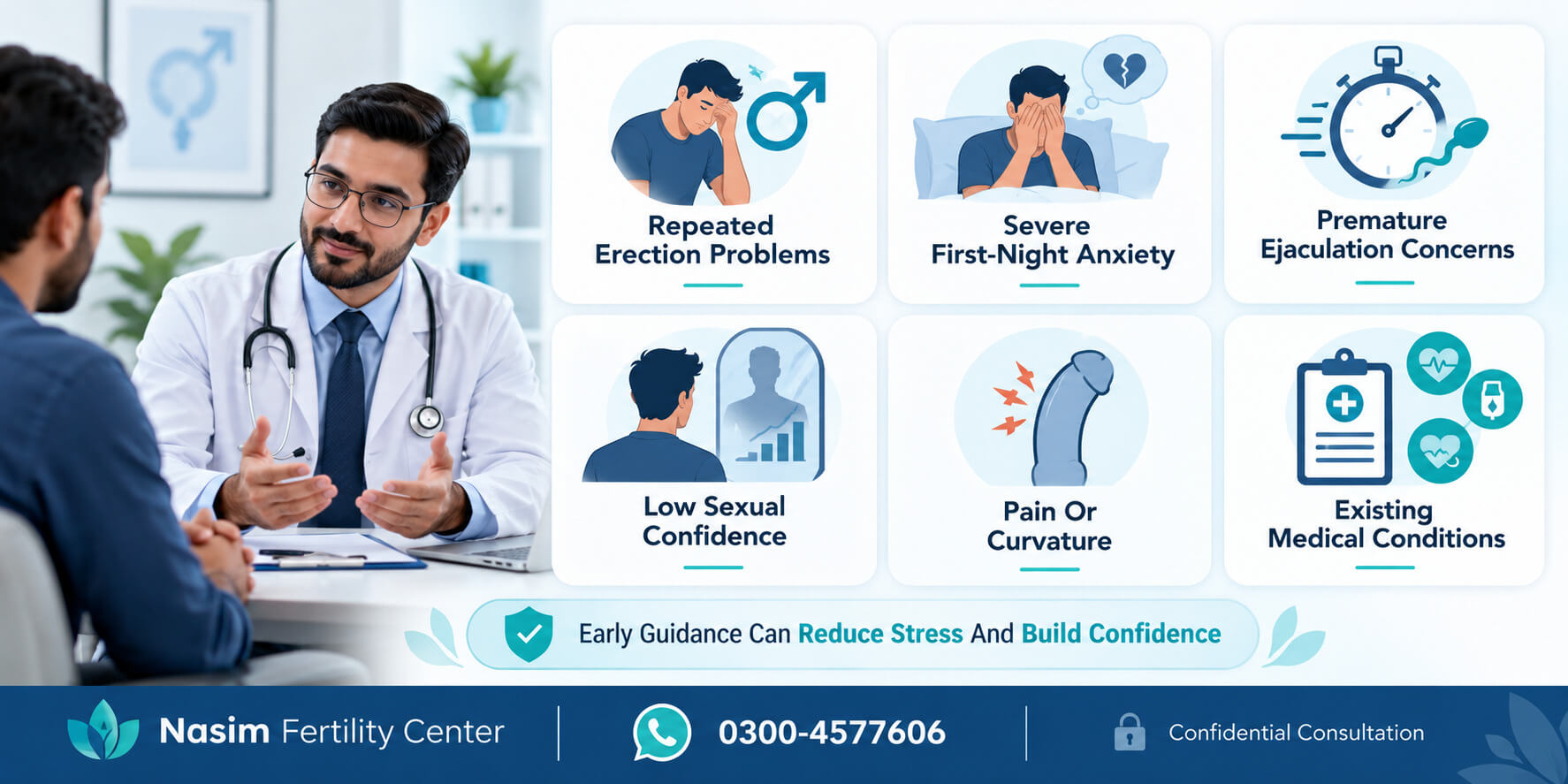
If you already have persistent erection difficulty, significant ejaculation concerns, low libido, fertility questions, penile pain or curvature, or strong performance anxiety, addressing the concern earlier gives more time for proper assessment.
Some conditions may only require reassurance or counseling. Others may need medical investigation or treatment over time.
Waiting until the night before the wedding and taking an unfamiliar sexual performance medicine is not a substitute for proper assessment.
Confidential Premarital Sexual Health Care With Dr. Farooq Nasim Bhatti
Dr. Farooq Nasim Bhatti of Nasim Fertility Center works with men experiencing erectile dysfunction, premature ejaculation, performance anxiety, sexual dysfunction, fertility concerns, masturbation related fears, and difficulties surrounding the start of married sexual life.
Premarital consultations focus on the individual’s symptoms and concerns, with testing or treatment recommended when clinically appropriate.
Confidential physical consultations are available through the clinic locations in Lahore, Islamabad, and Faisalabad, along with online consultation options for patients who cannot conveniently visit.
Worried About Your Sexual Health Before Marriage?
If your wedding is approaching and you already have concerns about erection, ejaculation, fertility, sexual confidence, or performance anxiety, you do not have to guess whether something is wrong.
A confidential medical assessment can help distinguish an actual sexual health problem from normal variation, misinformation, or anxiety and determine whether you need treatment at all.
Book A Confidential Consultation
Final Thoughts
You do not need to see a sexologist merely because you are getting married. Many healthy men enter marriage without requiring any sexual health testing or treatment.
A consultation becomes valuable when there is something specific to clarify. Persistent erection problems, ejaculation concerns, severe performance anxiety, low desire, fertility questions, genital symptoms, or fears about masturbation can all justify a professional discussion.
The aim is not to prove masculinity or guarantee a perfect wedding night. It is to understand your sexual health accurately, address genuine problems when they exist, and avoid entering marriage burdened by preventable fear, misinformation, or unnecessary medication.
Frequently Asked Questions
Should Every Man See A Sexologist Before Marriage?
No. A sexologist consultation is not medically necessary for every man before marriage. It becomes more useful when you have persistent sexual symptoms, significant anxiety, reproductive health concerns, or medical conditions that could affect sexual function.
Men without symptoms may still choose a consultation if they need reliable sexual health education or reassurance.
How Do I Know If I Need A Sexologist Before Marriage?
Consider consulting a sexologist if you repeatedly have difficulty getting or maintaining erections, have concerns about ejaculation, experience persistently low sexual desire, have genital pain or unusual curvature, are worried about fertility because of your history, or have severe anxiety about sexual performance.
The presence of one worry does not automatically mean you have a disorder. The consultation helps determine whether there is actually something to treat.
Can A Sexologist Check If I Am Sexually Fit For Marriage?
There is no single medical test that certifies someone as sexually fit for marriage.
A doctor can assess existing sexual function, medical history, reproductive concerns, and relevant risk factors. This can identify problems that may require attention, but it cannot guarantee future sexual performance.
Can A Doctor Tell If I Will Have Erectile Dysfunction After Marriage?
A doctor can assess current erection problems and risk factors, but cannot predict with certainty how your erections will respond in every future sexual situation.
Stress, partner comfort, stimulation, health, fatigue, and performance anxiety can all affect erections.
Should I Get A Semen Analysis Before Marriage?
Most men do not need routine semen analysis simply because they are getting married.
Testing may be appropriate when there is a specific fertility concern, previous reproductive problem, testicular condition, surgery, or another clinical reason for investigation.
How Can I Check My Fertility Before Marriage?
Male fertility assessment may involve medical history, physical examination, and semen analysis when appropriate. Additional testing may be used when a specific abnormality is suspected.
Remember that fertility and sexual performance are different. A man may have normal erections but abnormal sperm parameters, or erection problems with otherwise normal sperm production.
Does Masturbation Cause Sexual Problems After Marriage?
Masturbation should not automatically be blamed for future erectile dysfunction or infertility. Problems can arise when masturbation becomes compulsive, causes injury, is strongly associated with pornography, or creates severe anxiety about future sexual performance.
Men who believe they have permanently damaged themselves often benefit from proper medical clarification rather than sexual enhancement products.
Does Ejaculating Quickly During Masturbation Mean I Will Have Premature Ejaculation After Marriage?
Not necessarily. Masturbation and partnered intercourse involve different stimulation, circumstances, and psychological factors.
Premature ejaculation is assessed based on partnered sexual experience, control, pattern, and distress rather than masturbation timing alone.
What If I Cannot Get An Erection On My Wedding Night?
One episode of erection difficulty does not automatically indicate erectile dysfunction.
Exhaustion, nervousness, pressure to perform, lack of sleep, unfamiliarity with intimacy, and anxiety can all temporarily interfere with erections. If difficulty continues repeatedly, a medical assessment becomes more appropriate.
Is Penis Size Important For A Successful Marriage?
Sexual satisfaction is not determined by penis size alone. Emotional comfort, communication, arousal, stimulation, expectations, and overall sexual function are also important.
If you are concerned about unusual curvature, pain, or another structural issue, medical assessment is more useful than comparing yourself with unrealistic images or advertisements.
Can Performance Anxiety Cause Erection Problems After Marriage?
Yes. Anxiety can interfere with sexual arousal and make it more difficult to achieve or maintain an erection.
Men sometimes develop a cycle in which fear of losing an erection causes greater self monitoring, which then makes the erection less reliable.
Should I Take Viagra Before My Wedding Night?
You should not take prescription erectile dysfunction medicine simply as insurance against wedding night anxiety without appropriate medical advice.
Such medicines are intended for specific indications and may interact with other medications or medical conditions. If you are worried about erections before marriage, assessment is safer than experimenting with medication on an important night.
When Should I See A Sexologist Before My Wedding?
If you already have a persistent concern, there is little benefit in waiting until immediately before the wedding. Earlier consultation allows enough time to determine whether you need reassurance, counseling, medical investigation, or treatment.
If you have no symptoms and no significant concerns, a premarital sexologist visit is not mandatory.