
Getting married can bring excitement, anticipation, responsibility, and a considerable amount of stress. For some men, that stress becomes focused on one concern: “Will I be able to get and maintain an erection when the time comes?”
Yes, stress before a wedding can affect erections. Anxiety about the wedding night, fear of disappointing a partner, exhaustion, lack of sexual experience, and constantly monitoring sexual performance can temporarily interfere with arousal. One difficult experience does not automatically mean you have erectile dysfunction or permanent “mardana kamzori.” [1–3]
Understanding why this happens can prevent a temporary problem from turning into a cycle of fear and repeated erection difficulty.
Why Wedding Stress Can Affect Your Erection
An erection is not simply a mechanical response. The brain, nerves, emotions, blood vessels, hormones, and sexual stimulation all work together. [3,7]
When you feel relaxed and sexually aroused, your body is better able to support the blood flow required for an erection. When you become intensely anxious, however, your attention can shift away from pleasure and toward danger, failure, or self-monitoring. [3,5,7]
You may start thinking:
- “Is my erection hard enough?”
- “What if I lose it?”
- “What if I cannot satisfy my wife?”
Instead of experiencing intimacy naturally, you begin checking your body every few seconds. This can interfere with normal sexual arousal even when there is no significant physical problem with the penis.
Men experiencing a similar pattern can develop sexual performance anxiety, where fear about sexual performance starts contributing to the very difficulty they are trying to prevent. [3–5]
Experienced Care for Sensitive Sexual Health Concerns
Dr. Farooq Nasim Bhatti provides private and respectful consultation
for sexual health, fertility, and marriage-related concerns, backed
by more than 30 years of clinical experience.
Why Performance Anxiety Often Starts Before Marriage
Wedding-related erection anxiety can become especially strong when a man places enormous importance on his first sexual experience.
Some men also enter marriage worried that masturbation, semen loss, or previous sexual habits have caused permanent weakness. The fear itself may become a major source of performance anxiety.
Pressure to Perform on the First Night
Some men believe intercourse must happen successfully on the wedding night.
They may think an erection should appear immediately, penetration should happen easily, and they must satisfy their partner without hesitation.
Real intimacy does not follow such a fixed script.
Both partners may be nervous, physically exhausted, unfamiliar with each other’s sexual responses, or simply not ready for intercourse immediately.
For some men, the fear goes beyond sexual performance. They may worry that if intercourse does not happen, their wife may think they are sexually incapable, discuss the problem with family members, or even consider ending the marriage.
That pressure can make anxiety considerably worse.
Fear of Disappointing Your Partner
A groom may worry about erection strength, ejaculation timing, penis size, stamina, or whether his wife will consider him sexually capable.
Once these thoughts become intense, attention shifts away from attraction, touch, and physical sensation.
Sexual intimacy begins to feel like an examination that must be passed.
Limited Sexual Experience
In Pakistan and other conservative societies, many people marry without previous partnered sexual experience. There is nothing abnormal about this.
However, unfamiliarity with foreplay, arousal, penetration, communication, and a partner’s comfort can create uncertainty.
A private premarital consultation can be useful when a man already has significant concerns about erections, ejaculation, sexual fears, masturbation-related misconceptions, or what to expect after marriage.
Wedding Exhaustion and Lack of Sleep
The days around a wedding may involve poor sleep, travelling, guests, ceremonies, financial pressure, irregular meals, and emotional exhaustion.
You may feel mentally excited about intimacy while your body is simply tired.
A weak erection after an exhausting wedding day does not by itself establish a diagnosis of erectile dysfunction.
The Performance Anxiety And Erection Cycle
One unsuccessful attempt can create stronger anxiety during the next attempt.
The cycle may look like this:
Wedding pressure → fear of erection failure → checking erection strength → reduced arousal → weaker erection → greater fear during the next attempt
This explains why a man may have had normal erections before marriage but suddenly struggle when intercourse becomes expected.
The erection then becomes the focus of every intimate moment. Instead of responding naturally to touch and attraction, the man waits anxiously to see whether his erection will remain firm.
Breaking this cycle often requires reducing performance pressure rather than repeatedly testing sexual function. Psychological and behavioural interventions may help selected men with psychogenic erectile difficulties. [4–6,8]
What If You Get An Erection Until Penetration?
This is a common concern among newly married men. A man may become erect while talking, kissing, touching, or during foreplay, but the erection weakens when he attempts penetration.
That pattern can occur with performance anxiety. The moment penetration becomes the goal, thoughts such as “Now I have to perform” or “What if it disappears again?” may interrupt arousal. [1,3]
Dr. Farooq Nasim Bhatti’s 2015 research on psychogenic ED in non-consummated marriages specifically described heightened performance pressure during sexual activity among affected men. [1]
It does not prove that the problem is psychological, however. If the pattern continues, an evaluation can help determine whether anxiety, technique, relationship factors, physical ED, or a combination is involved.
What If You Have Morning Erections But Struggle With Your Partner?
Regular morning or spontaneous erections can provide useful information. If erections remain strong during sleep, in the morning, or during masturbation but become difficult mainly during partnered sex, situational anxiety may be contributing. [3]
Morning erections should not be used as a home test to rule out every medical problem. Physical and psychological factors can occur together, so persistent symptoms still deserve proper assessment. [3,7,10]
Psychogenic ED is treatable, and treatment focuses on addressing the psychological, sexual, behavioral, and relationship factors that are interfering with normal sexual response.
However, morning erections should not be used as a home test to rule out every medical condition. Physical and psychological causes can occur together, so persistent erection problems still deserve proper assessment.
Is It Erectile Dysfunction Or Wedding Anxiety?
There is no single sign that allows you to diagnose the cause at home. The overall pattern gives the doctor important clues.
Anxiety may be contributing more strongly when erection difficulty begins suddenly around marriage, erections remain normal at other times, the problem appears mainly with a partner, or the erection weakens specifically when penetration is attempted.
A physical cause deserves greater consideration when erections have gradually become weaker in different situations, morning erections have noticeably changed, sexual desire is persistently low, or the man has conditions such as diabetes, cardiovascular disease, hormonal problems, or medication use that may affect sexual function.
Psychological and physical erectile dysfunction are not always completely separate. A man may have predominantly psychogenic ED or predominantly organic ED, while still having factors from both categories.
For example, a mild physical difficulty can create anxiety, and that anxiety can then make the erection problem much more noticeable.
Your Privacy Matters at Every Step
Sexual health concerns can feel difficult to discuss. Dr. Farooq Nasim Bhatti offers a professional, non-judgmental environment where your symptoms and questions are handled privately.
What To Do Before Your Wedding If You Are Worried About Erections
Repeatedly trying to prove to yourself that you can get an erection usually increases anxiety.
Before your wedding, focus on maintaining good sleep, regular physical activity, and realistic expectations about intimacy. Avoid repeatedly checking erections or comparing yourself with pornography, stories, or other people’s experiences.
Do not take sexual performance medicines without medical advice simply because you are worried about the wedding night.
Intercourse also does not have to happen immediately. Comfort, communication, affection, foreplay, and gradual intimacy are more important than treating penetration as a test.
If you already have recurring erection problems before marriage, waiting until the wedding night to see what happens may create additional pressure. A professional assessment beforehand can help clarify whether treatment or counseling is needed.
What If You Cannot Get An Erection On Your Wedding Night?
One unsuccessful sexual encounter should not lead you to conclude that you are impotent.
Wedding-night exhaustion, nervousness, unfamiliarity, fear of penetration, lack of privacy, and pressure to perform can all affect sexual response.
Becoming alarmed after the first attempt can make the second attempt more difficult.
Avoid repeatedly forcing intercourse simply to prove that penetration is possible. Reduce pressure, spend time becoming comfortable with your partner, and allow intimacy to develop naturally.
Also avoid withdrawing emotionally because you feel embarrassed. Your wife may incorrectly interpret the problem as a lack of attraction, while you may become even more anxious because you believe she is disappointed.
What If The Problem Continues After Marriage?
If erection difficulty happens repeatedly, avoiding the problem can make anxiety worse.
A man may start expecting failure before every intimate encounter, and the couple may gradually avoid sexual contact altogether.
This is how an isolated wedding-night difficulty can develop into a more established pattern of psychogenic ED or contribute to a non-consummated marriage.
A non-consummated marriage does not automatically mean the husband is impotent. Difficulty completing intercourse can involve erection loss, severe performance anxiety, premature ejaculation before penetration, lack of sexual knowledge, fear, vaginismus, pain, or factors affecting both partners.
Dr. Farooq Nasim Bhatti’s research on psychogenic ED in non-consummated marriage also reflects the importance of assessing psychological, sexual, and relationship factors rather than focusing on erection medication alone. His 2015 conference presentation reported on 4,250 patients treated for non-consummated marriages and described performance pressure as a prominent feature among patients classified as having psychogenic dysfunction. [1]
Can Wedding Stress Cause Permanent Erectile Dysfunction?
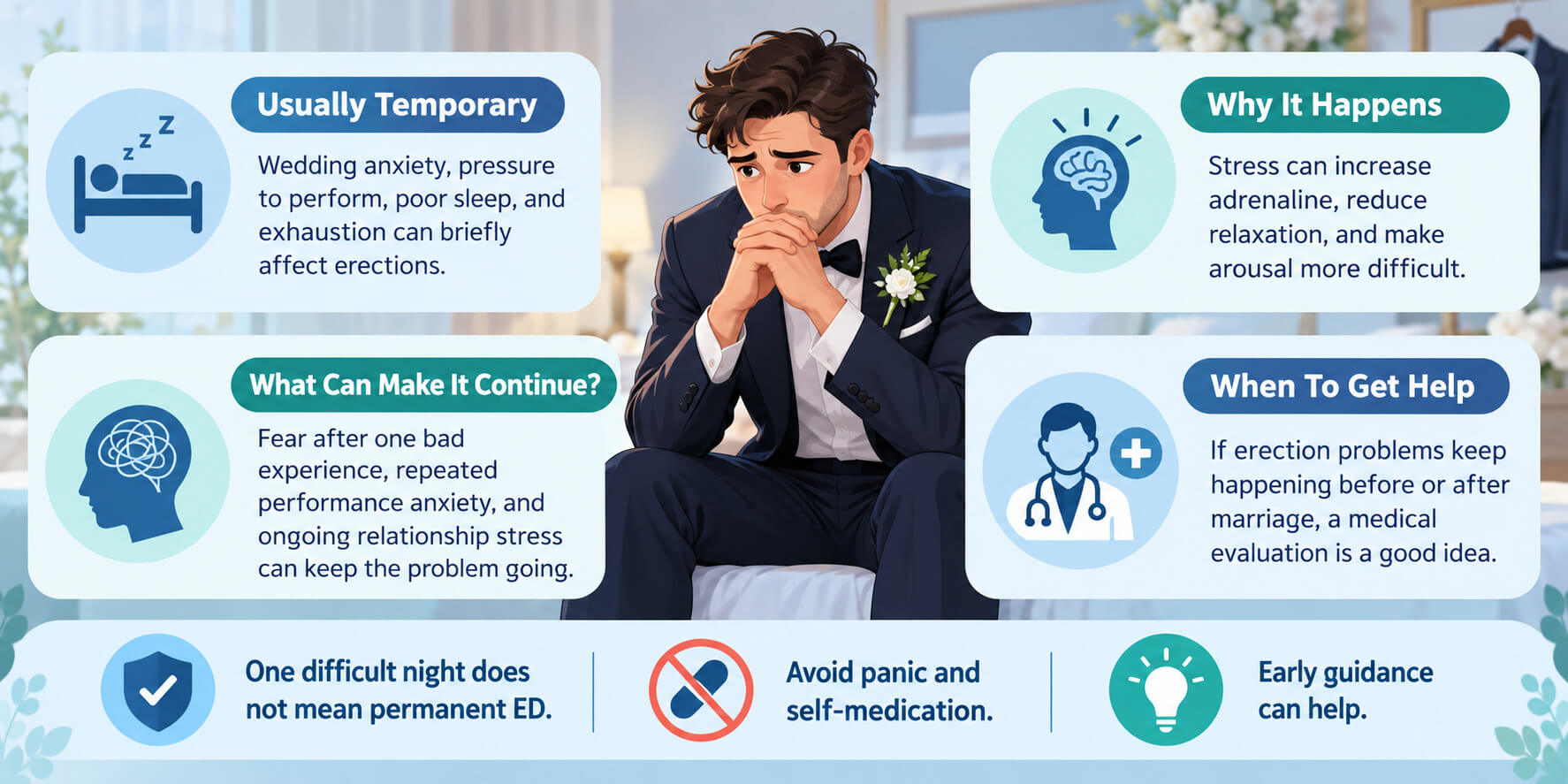
Wedding stress itself does not mean a man has developed permanent erectile dysfunction.
Situational erection difficulty may improve as anxiety decreases and the couple becomes more comfortable with intimacy.
The larger concern is the psychological cycle that can develop after repeated unsuccessful attempts. When every sexual encounter becomes associated with fear, the expectation of failure may continue even after the original wedding stress has passed.
Persistent problems are therefore better assessed early rather than allowing months of fear, avoidance, self-diagnosis, and relationship stress to develop.
Should You Take Viagra Before Your Wedding?
Do not take sildenafil, tadalafil, herbal “male power” products, desi medicines, delay products, or sexual supplements simply because you are worried about the wedding night.
Prescription ED medicines can be useful for appropriate patients, but they are not a substitute for determining why erection difficulty is occurring. They can also interact with certain medications and medical conditions. [9,10]
For some men, the main problem is performance anxiety rather than inadequate blood flow. Medication taken without assessment may temporarily mask the concern without addressing the fear that returns during future encounters.
Research on psychogenic ED also supports considering psychological interventions rather than relying exclusively on erection medication when psychological factors are significant. [4,6,8]
When Should You See A Doctor Before Or After Marriage?
You do not need to wait until a marriage has remained unconsummated for months before asking for help.
Consider professional assessment if you repeatedly struggle to get or maintain an erection, erections have become weak in different situations, sexual desire is very low, severe performance anxiety is developing, or premature ejaculation is interfering with intercourse.
Medical assessment is also important if you have diabetes, high blood pressure, cardiovascular disease, hormonal problems, penile pain, significant curvature, or another condition that may affect sexual function.
Repeated unsuccessful attempts that are creating serious marital stress should also be evaluated.
A proper assessment can help determine whether the problem is predominantly psychological, predominantly physical, or mixed.
How A Sexologist Evaluates Pre Wedding Erection Concerns
A detailed assessment is not limited to asking whether the penis becomes erect.
Dr. Farooq Nasim Bhatti may take a detailed sexual, medical, social, and relationship history to understand when the difficulty occurs, whether erections happen normally at other times, when symptoms began, and whether anxiety appears before sexual activity.
Relevant medical conditions, medications, sleep, smoking, relationship concerns, sexual expectations, masturbation-related fears, and previous experiences may also be discussed.
Physical examination or laboratory testing may be recommended where the history suggests a possible medical cause.
When psychological or relationship factors are significant, sex therapy and counseling may form an important part of treatment alongside medically appropriate treatment.
Dr. Bhatti follows a biopsychosocial approach, which considers biological, psychological, sexual, behavioral, and relationship factors together.
Confidential Pre Marriage Men’s Health Consultation
Men approaching marriage sometimes carry concerns they have never felt comfortable discussing, including erection strength, premature ejaculation, masturbation related fears, first night anxiety, or doubts about whether they will be able to complete intercourse.
Nasim Fertility Center provides confidential assessment with Dr. Farooq Nasim Bhatti for men experiencing sexual dysfunction and marriage related sexual concerns. With more than 30 years of experience in sexual medicine, his approach considers physical health, performance anxiety, sexual misconceptions, and relationship factors before recommending an individualized management plan.
Dr. Farooq Nasim Bhatti has also presented international research on psychogenic sexual dysfunction and psychogenic erectile dysfunction associated with non-consummated marriages, including presentations in Singapore in 2015 and Busan, Korea in 2016. [1,2]
Consultations are available for patients who prefer an in person visit in Lahore, Islamabad, or Faisalabad, as well as those who need a private online consultation.
Final Thoughts
Stress before a wedding can affect erections, especially when sexual intimacy becomes connected with fear, expectations, and pressure to perform perfectly.
One difficult night does not define your sexual health and does not automatically mean you have permanent erectile dysfunction.
Focus on comfort, sleep, communication, affection, and gradual intimacy rather than treating penetration as a test.
If erection problems continue before or after marriage, a proper medical, psychological, and sexual assessment can identify the factors involved and guide appropriate treatment.
Frequently Asked Questions
Can Stress Before A Wedding Cause Erectile Dysfunction?
Stress can temporarily make it difficult to achieve or maintain an erection. Anxiety activates the body’s stress response, including the release of adrenaline, which can interfere with normal sexual arousal.
Persistent erection difficulty should still be evaluated because psychological and physical factors can occur together.
Is It Normal To Lose An Erection When Nervous?
Yes. Nervousness can interfere with arousal and cause an erection to weaken.
This may happen during a first sexual experience, after a previous unsuccessful attempt, or whenever a man feels that he must perform perfectly.
Why Can I Get An Erection Alone But Not With My Partner?
This pattern may suggest that performance anxiety, relationship context, fear of penetration, or excessive self-monitoring is interfering with sexual arousal.
However, this pattern alone is not enough to diagnose psychogenic ED, particularly if the problem continues.
Why Do I Lose My Erection When Trying To Penetrate?
For some men, penetration is the moment when intimacy begins to feel like a performance test.
Anxiety rises, attention shifts away from sexual stimulation, and the erection may weaken or disappear.
Is It Normal To Have No Erection On The First Night?
A single episode can happen because of exhaustion, nervousness, pressure, unfamiliarity, lack of privacy, or other temporary factors.
It should not automatically be interpreted as permanent impotence.
Can One Failed Attempt Cause Performance Anxiety?
Yes. After an unsuccessful attempt, a man may become afraid that the same thing will happen again.
That fear can increase self-monitoring and make it more difficult to become naturally aroused during the next attempt.
Can Psychological Erectile Dysfunction Be Treated?
Psychogenic erectile dysfunction can often improve when anxiety, fear, misconceptions, relationship factors, and sexual behavior patterns are properly addressed.
Dr. Bhatti uses a biopsychosocial approach that may include sex therapy, counseling, and medically appropriate treatment depending on the individual case.
When Should I See A Sexologist Before Marriage?
Consider consultation if you already experience repeated erection difficulty, weak erections, difficulty maintaining an erection, premature ejaculation, very low sexual desire, severe performance anxiety, or fears that are making you dread intimacy after marriage.
Getting appropriate guidance before the wedding can help reduce unnecessary panic and repeated unsuccessful attempts.
References
- Bhatti FN. Psychogenic Erectile Dysfunction in Non-Consummated Marriages That Are Non-Responsive to PDE5 Inhibitors, Are to Be Treated by IC Drugs, Pharmacotherapy and Psychotherapy. Presented at the 22nd Congress of the World Association for Sexual Health, Singapore; 2015.
- Bhatti FN. Comprehensive Treatment of Male Psychogenic Sexual Dysfunction by Sex Therapy and Psychotropic Drugs (Without PDE5 Inhibitors). Presented at the 14th Congress of the Asia Oceania Federation of Sexology, Busan, Korea; 2016.
- Rosen RC. Psychogenic erectile dysfunction: a critical approach. International Journal of Impotence Research. 2001;13(Suppl 3)–S47.
- Melnik T, Soares BGO, Nasello AG. The effectiveness of psychological interventions for the treatment of erectile dysfunction: a systematic review and meta-analysis. Journal of Sexual Medicine. 2007;4(6):1497–1512.
- Aubin S, Heiman JR. Cognitive-behavioral therapy for sexual dysfunctions. In: Cognitive-Behavioral Therapies. American Psychological Association; 2004:346–369.
- Banner LL, Anderson RU. Integrated sildenafil and cognitive-behavioral therapy for erectile dysfunction: a pilot study. Journal of Sexual Medicine. 2007;4(4):1117–1125.
- McCabe MP, et al. Psychological and interpersonal dimensions of sexual function and dysfunction. Journal of Sexual Medicine. 2016;13(4):538–571.
- Althof SE, Needle RB. Psychological interventions for the treatment of erectile dysfunction. Journal of Sexual Medicine. 2011;8(Suppl 4):289–296.
- Carson CC, Lue TF. Phosphodiesterase type 5 inhibitors for erectile dysfunction. BJU International. 2005;95(3):259–264.
- Montorsi F, et al. Summary of the recommendations on sexual dysfunctions in men. Journal of Sexual Medicine. 2010;7(11):3572–3588.