
When a man says he is “losing timing” during intercourse, he may mean that he ejaculates sooner than he wants, cannot maintain his erection long enough, or takes much longer than usual to reach ejaculation. These are different sexual concerns, even though men often describe all of them simply as a timing problem.
Occasional changes in sexual timing are common. Excitement, stress, tiredness, a long gap between sexual encounters, or anxiety with a partner can all change how the body responds. However, when the problem happens repeatedly and starts affecting confidence, intimacy, or the relationship, it is worth understanding what is actually happening rather than simply looking for a “timing tablet.”
What Does Losing Timing During Intercourse Actually Mean?
“Sex timing” is not a medical diagnosis. Before thinking about treatment, it is important to identify what the man is experiencing during intercourse.
If ejaculation repeatedly happens much sooner than desired and there is difficulty delaying it, the problem may be premature ejaculation (PE). If the erection becomes soft or disappears before intercourse can be completed, the concern may be erectile dysfunction (ED). A man who remains aroused but needs an unusually long time to ejaculate, or cannot ejaculate despite adequate stimulation, may instead be experiencing delayed ejaculation.
This distinction matters because these problems do not necessarily have the same causes or treatment. ManHealth has separate guidance on premature ejaculation treatment, while men who take unusually long to climax can read more about delayed ejaculation and its causes.
Why Do Some Men Ejaculate Too Quickly During Intercourse?
For many men who complain that their sex timing has decreased, the actual concern is early ejaculation. The man can achieve an erection and have intercourse, but reaches climax before he wants to and feels unable to control the process.
There is rarely one explanation for every case. Sexual excitement, anxiety, biological factors, relationship stress, learned sexual patterns, and erection concerns may all influence ejaculation.
Performance Anxiety
Sexual performance requires arousal, but excessive monitoring can interfere with it. A man may enter intercourse thinking, “How long will I last?” or “What if I finish too quickly?” Instead of experiencing intimacy naturally, he begins monitoring every physical sensation.
One disappointing experience can then create another. The man worries about ejaculating early, becomes more anxious during the next encounter, notices every change in arousal, and again loses control. Over time, fear of early ejaculation can become almost as disruptive as the original problem.
High Excitement And Long Gaps Between Sex
Not every episode of early ejaculation means that a man has premature ejaculation. After a long period without intercourse, during a new relationship, or when sexual excitement is unusually high, ejaculation may occur faster than usual.
The important question is whether this happens occasionally or during most sexual encounters. Persistent difficulty controlling ejaculation deserves more attention than an isolated experience.
Why Has My Sex Timing Suddenly Decreased?
A sudden change deserves particular attention when a man previously had satisfactory ejaculation control. This is different from someone who has experienced very rapid ejaculation since his earliest sexual experiences.
New stress at work or home, relationship tension, poor sleep, exhaustion, erection difficulties, changes in medication, and some physical health conditions can coincide with a change in sexual performance. Urinary or prostate symptoms may also be relevant when the timing change appears alongside pain, burning, pelvic discomfort, or other new symptoms.
Instead of assuming that the body has simply become “weak,” consider what else changed around the same time. If the decrease persists, a medical and sexual history can help identify whether the main issue is ejaculation, erection, anxiety, or another underlying condition.
Can Erectile Dysfunction Make You Lose Timing?
Erectile dysfunction does not always mean that a man cannot get an erection at all. Some men become erect normally but have difficulty maintaining that erection throughout intercourse.
This can indirectly shorten sex timing. A man who is afraid his erection will disappear may rush intercourse and try to reach ejaculation while the erection is still firm. The more he monitors the erection, the more anxious he may become. Early ejaculation and erection difficulty can therefore exist together.
If the main problem is getting or maintaining an erection rather than controlling ejaculation, treating it simply as premature ejaculation may miss the real issue. Our guide to erectile dysfunction and its treatment explains how erection difficulties can present and why identifying their cause matters.
How Does Performance Anxiety Affect Sex Timing?
The brain plays a major role in erection, arousal, orgasm, and ejaculation. When attention shifts from intimacy to constant self evaluation, the sexual response can become less predictable.
A man may repeatedly ask himself whether his erection is strong enough, whether his partner is satisfied, or whether he has lasted long enough. Some men respond by ejaculating rapidly. Others lose their erection. Another person may become so distracted that ejaculation becomes difficult.
This is why psychological and physical causes should not always be treated as completely separate. When anxiety is an important part of sexual dysfunction, professional sex therapy and counseling can address the thoughts, fears, relationship pressures, and sexual behaviors contributing to the problem.
Semen Loss Fears And Sexual Timing In Pakistani Men
Sexual concerns in Pakistan also need to be understood within their cultural context. Some men grow up believing that masturbation, nightfall, pre ejaculatory fluid, or semen loss permanently drains physical strength. A normal sexual experience can then become a source of guilt and fear.
A man who believes he has damaged himself may enter marriage already expecting sexual failure. He may closely monitor his erection and ejaculation, interpret ordinary fluctuations as proof of weakness, and become increasingly anxious.
Dr. Farooq Nasim Bhatti has specifically studied Dhant or Jaryan and culturally influenced sexual concerns in Pakistani men. Men worried about white discharge or semen loss can read the dedicated explanation of Dhant or Jaryan, including how these concerns are assessed rather than automatically treating every discharge as evidence of weakness.
Does Masturbation Reduce Sex Timing?
Masturbation itself does not mean that a man will permanently lose his sexual timing or become sexually weak. The more useful question is whether a particular sexual habit has affected how he responds to stimulation.
For example, someone who repeatedly masturbates as quickly as possible because he is afraid of being discovered may become accustomed to rushing toward ejaculation. Anxiety or guilt about masturbation can also affect sexual confidence with a partner.
This does not mean that the penis has been permanently damaged. Men concerned about this subject can read more about masturbation and male sexual health rather than assuming that every change in timing is proof of irreversible weakness.
Why Am I Only Lasting 30 Seconds?
If ejaculation occurs within 30 seconds once, particularly after a long gap or during unusually high excitement, that single episode does not establish a sexual disorder.
The concern becomes more significant when ejaculation repeatedly occurs very soon after penetration, the man cannot delay it despite wanting to, and the pattern causes frustration or relationship distress. In that situation, premature ejaculation should be considered.
Timing should therefore be assessed as a pattern rather than judged from one encounter.
How Long Should A Man Last During Intercourse?
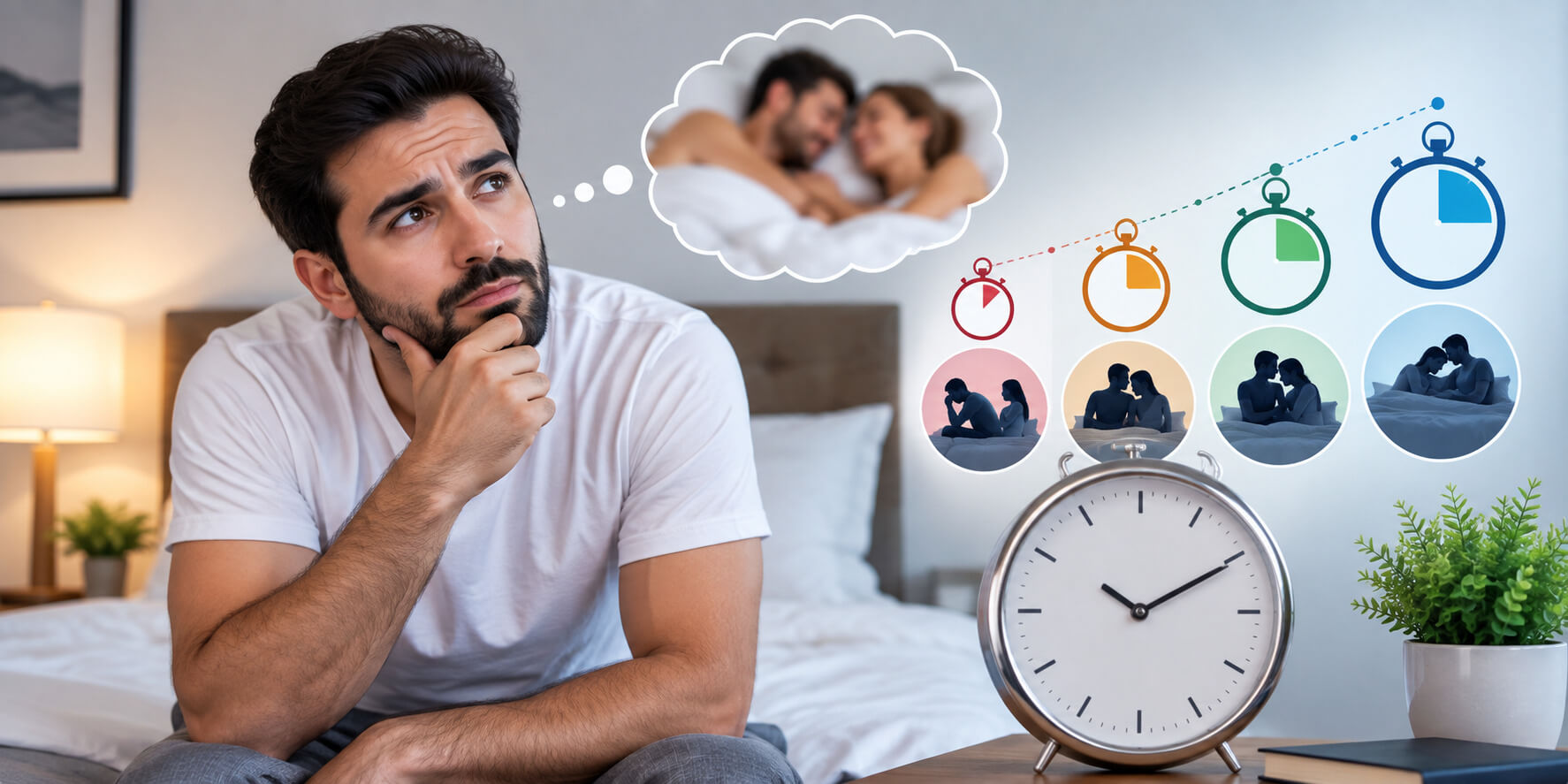
There is no rule stating that a healthy man must continue penetration for 20, 30, or 60 minutes. Pornography, exaggerated stories, and online claims have created unrealistic expectations about normal male sex timing.
When researchers discuss intercourse duration, they usually measure the period from vaginal penetration until ejaculation rather than the entire intimate encounter. Our detailed guide on how long a healthy man normally lasts during sex explains why around five to seven minutes is a realistic average range for penetrative intercourse, while individual experiences naturally vary.
More time is not automatically better sexual health. Control, erection quality, comfort, communication, and satisfaction are more meaningful than trying to achieve an arbitrary number on a stopwatch.
How Can Men Improve Timing During Intercourse?
The right approach depends on why the timing has changed. A man with performance anxiety does not necessarily need the same treatment as someone with lifelong premature ejaculation or an erection problem.
Behavioral approaches such as the stop start technique may help some men recognize the point at which ejaculation becomes difficult to control. Pelvic floor exercises can also be useful in selected cases when performed correctly. Stress reduction, regular physical activity, sufficient sleep, and better general health can support sexual function as well.
When premature ejaculation is persistent, treatment may involve a combination of:
- Behavioral techniques to develop better ejaculation control
- Counseling or sex therapy when anxiety is contributing
- Medical treatment when clinically appropriate
- Treatment of erectile dysfunction if erection instability is driving the problem
- Couple counseling when relationship pressure is maintaining the cycle
The goal should not simply be to add minutes. It should be to identify why control has changed and address that cause.
Do Timing Tablets And Delay Sprays Solve The Problem?
Men looking for a quick solution are often attracted to timing tablets, supplements, oils, creams, and numbing sprays. Some topical products can temporarily reduce penile sensitivity and delay ejaculation, but that does not mean they correct the underlying cause.
Too much numbing product may reduce sensation excessively and can interfere with sexual pleasure. Depending on how a topical product is used, sensation may also be transferred to a partner. Medicines can have side effects and interactions, so taking an unknown “timing tablet” without knowing what it contains is not a sensible substitute for diagnosis.
There is also no single medicine that treats every type of timing problem. Premature ejaculation, erectile dysfunction, delayed ejaculation, and performance anxiety require different approaches.
When Should You See A Doctor About Sex Timing?
Occasional variation is normal, but medical advice becomes more useful when the problem persists. Consider an evaluation if ejaculation happens too quickly during most encounters, your timing has suddenly changed, you regularly lose your erection, or anxiety is making you avoid intimacy.
Pain, urinary symptoms, pelvic discomfort, a major change in sexual desire, or other new physical symptoms are additional reasons not to rely only on self treatment.
Sex Timing Treatment At Nasim Fertility Center
Dr. Farooq Nasim Bhatti has more than 31 years of experience working with male sexual dysfunction, including premature ejaculation, erectile dysfunction, Dhant or Jaryan, performance anxiety, and non consummated marriage. His clinical approach at Nasim Fertility Center includes assessment, sex therapy, counseling, and medical treatment according to the individual problem.
The important first step is identifying what “losing timing” actually means for that patient rather than treating every man with the same solution. Consultations are available at clinics in Lahore, Islamabad, and Faisalabad, with online sexologist consultations also available for patients who cannot visit a clinic.
Timing Is About Control, Not A Stopwatch
Sexual performance should not be judged only by how many minutes intercourse lasts. A man who lasts five minutes with comfortable control and mutual satisfaction may have healthier sexual function than someone who forces himself to continue for much longer while feeling anxious or disconnected.
If timing has changed repeatedly, focus first on whether the problem is early ejaculation, erection loss, delayed ejaculation, or performance anxiety. Once the actual problem is identified, treatment can address the cause rather than simply trying to increase a number on the clock.
Frequently Asked Questions
How Can A Male Last Longer During Intercourse?
Improving timing depends on the cause. Behavioral techniques, reducing performance anxiety, pelvic floor training, treating erection problems, and medical treatment for premature ejaculation may help. There is no single method that works for every man.
Why Am I Only Lasting 30 Seconds?
An occasional 30 second experience can happen because of excitement or a long gap between sexual encounters. If it occurs repeatedly and you cannot delay ejaculation despite wanting to, it may indicate premature ejaculation.
Why Do Men Pause During Intercourse?
Pausing is not necessarily a sign of a problem. Some men intentionally slow or stop stimulation to reduce arousal and delay ejaculation. Others pause because of fatigue, communication with their partner, discomfort, or changes in their erection.
Can Stress Reduce Male Sex Timing?
Yes. Stress and performance anxiety can interfere with sexual arousal and ejaculation control. Depending on the individual, anxiety may contribute to early ejaculation, erection loss, or difficulty reaching orgasm.
Is Losing Timing The Same As Premature Ejaculation?
Not always. A man may use “losing timing” to describe premature ejaculation, difficulty maintaining an erection, or delayed ejaculation. Identifying what actually happens during intercourse is necessary before deciding on treatment.
Can Sex Timing Improve Without Medicine?
Yes, depending on the cause. Some men improve through behavioral techniques, counseling, anxiety management, lifestyle changes, or treatment of relationship factors. Other cases may require medical treatment.